

Think That Free Rent Deal Helps? Check the Lease Math First
You spot an apartment ad promising a free final month, and for a moment the move looks easier on your budget. Then the paperwork starts: higher move-in charges, a larger security deposit, extra admin fees, mandatory packages, or a lease term that makes the deal less generous than it first seemed. That is why renters should treat a “last month free” offer as a math problem, not just a marketing perk.
These promotions can be perfectly real, but they do not always lower your total housing cost as much as the headline suggests. In many cases, the real question is whether the credit is worth the tradeoffs hidden elsewhere in the lease. General renter guides on apartment move-in costs and rental add-on charges show how fast one-time and recurring fees can pile up beyond the advertised base rent.
If a leasing office is offering a free final month, slow the process down. The smartest move is to compare the full lease cost, check when the discount actually applies, and ask what money you still need up front before you count the promotion as savings.
What a free final month usually means in plain language
A rent concession is often real, but it may be applied later, spread out, or tied to strict conditions.
The headline promise sounds simple, yet the timing of the credit often matters as much as the amount.
Many renters hear “free final month” and assume they will move in with less cash due. Often that is not how it works. A property may still require the first month, security deposit, application charges, amenity fees, pet charges, parking, and utility setup money before handing over keys. The concession may apply only if you complete the full lease term without breaking it early.
That detail matters because a delayed credit helps your total cost more than your move-in budget. If the rent is $1,500 and the last month is waived, that sounds like a big win. But if you still need $3,000 to $5,000 up front to move in, the immediate cash pressure may not improve much at all.
It is also worth asking whether the concession is shown as a true last-month waiver or as a prorated discount spread over the lease. Some properties advertise one thing and document another. Legal explainers on last month’s rent rules can help renters understand the difference between a promotional credit and actual prepaid last-month rent.
Ask the leasing office for a written breakdown showing:
- Base monthly rent
- Lease length
- When the rent credit applies
- Whether the discount is lost if you move out early
- What is still due before move-in
That one page can reveal whether the offer improves your real budget or just sounds good in the ad.
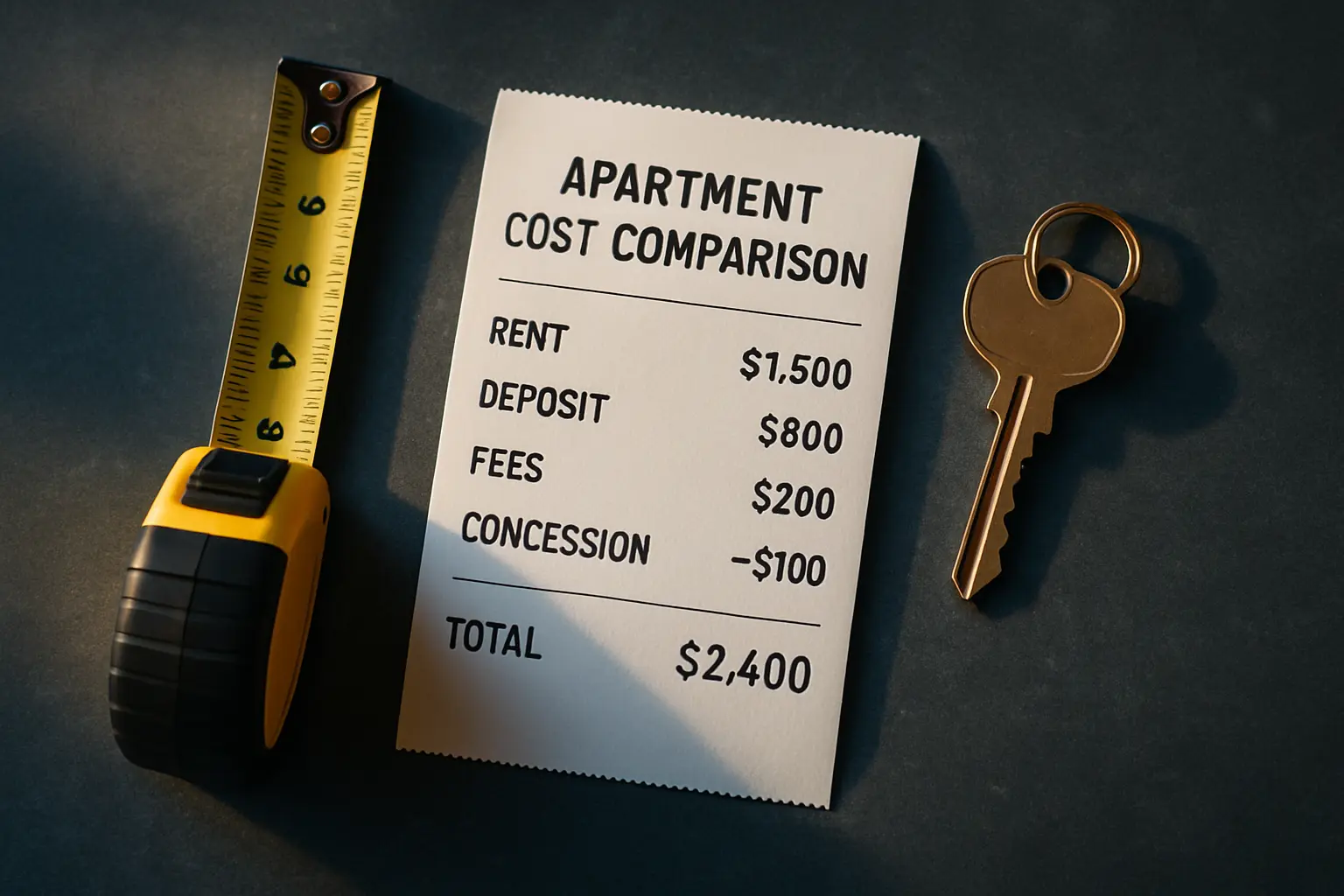
The move-in bill can wipe out the promo faster than you expect
The biggest trap is focusing on one free month while ignoring the pile of charges due before day one.
A concession at the end of the lease does not erase a heavy move-in total at the start.
Renters often compare apartments by monthly rent and overlook the check or card charge required to actually get in the door. Standard move-in costs may include an application fee, admin fee, holding fee, security deposit, pet deposit, pet rent, key or fob charge, parking, mailroom fee, trash service, internet bundle, and utility deposits. Articles on hidden renting expenses and common apartment fees show how routine these extras have become.
Here is where the math gets real. If Apartment A offers a free final month but asks for a $2,000 security deposit plus $500 in add-ons, and Apartment B charges slightly higher monthly rent with far lower move-in costs, Apartment B may actually be easier and cheaper for your household.
Try comparing two totals:
- Total money due before move-in
- Total cost across the full lease term
Keep them separate. Some households can handle a slightly higher annual cost but cannot absorb a huge first-week bill. Others care more about total yearly cost because savings are tight all year.
Also ask whether any deposit is refundable, partially refundable, or automatically turned into a fee. A refundable deposit is not the same as a nonrefundable admin charge, even if both are collected at move-in.
If your biggest challenge is cash upfront, a “free later” deal may not solve the problem you actually have.
Higher monthly pricing can quietly claw back the value
Some promotions are offset by rent or required fees that keep running long after the ad got your attention.
A free month does not always mean the unit is cheaper than nearby options with a lower everyday cost.
One apartment may offer a flashy concession while setting rent above similar units in the same area. Another may attach recurring charges that continue every month: reserved parking, technology package, shared utility billing, package handling, pest control, or mandatory insurance-like programs. A promotion can still be legitimate and still be a weaker deal than a simpler lease with lower monthly overhead.
This is why renters should calculate the effective monthly cost. Add up all rent due across the full term after the concession, then add recurring required fees, then divide by the number of lease months. That gives you a much clearer comparison point.
For example, a 12-month lease at $1,600 with one waived month means $17,600 in base rent for the year. Divide that by 12 and your effective base rent becomes about $1,467. But if there is also $125 in required monthly extras, the effective monthly housing cost jumps closer to $1,592. Suddenly the deal may look less special.
Guides on so-called free apartment perks often note that giveaways can be paired with pricing that recovers the value elsewhere. That does not mean every offer is bad. It means side-by-side comparison matters more than the promotion headline.
When you ask for pricing, request a list of all mandatory monthly charges, not just the posted rent. If something is unavoidable, treat it like rent in your budget.
Deposit rules and end-of-lease conditions deserve extra attention
The most expensive surprise may come when a renter assumes the concession and the deposit work together in a way the lease does not actually allow.
A waived final rent charge is not the same thing as getting your deposit back or skipping end-of-lease obligations.
Some renters mistakenly think a free final month means they can stop worrying about lease-end charges. In reality, the property can still inspect the unit, deduct valid damages from the security deposit under applicable law, and bill for unpaid charges allowed by the lease. The rent concession usually does not protect you from cleaning charges, repair claims, utility balances, or penalties if the lease says those costs survive move-out.
Another risk is losing the concession entirely if you break the lease early. Many promotions are conditional. If you move for a job, roommate issue, family problem, or safety concern before the term ends, the landlord may treat the waived month as something you now owe back under the agreement. That possibility should be spelled out in writing.
Read carefully for language about:
- Lease-break charges
- Clawback of concessions
- Whether the deposit can be used for rent
- Move-out notice deadlines
- Final utility or damage billing
Nolo’s overview of last-month rent concepts is helpful here because renters often mix up deposit money, prepaid rent, and promotional rent credits. They are not interchangeable.
If you are unsure, ask one direct question: “If I complete the lease normally, what exact charges could still be billed after the free month applies?” The answer can tell you whether the deal is clean or full of end-game risk.
How to judge whether the offer truly fits your budget
The best apartment deal is the one that matches your cash flow, not the one with the most eye-catching slogan.
A promotion helps only when the timing, fees, and lease terms actually line up with your household’s needs.
A renter with solid savings but a tight long-term budget may genuinely benefit from a concession that lowers annual cost. A renter short on move-in cash may need lower deposits and fewer up-front fees more than a future credit. Someone expecting job uncertainty may want a lease with fewer penalty risks, even if the headline perk looks smaller.
Use a simple decision sheet before signing:
- How much cash is due before move-in?
- What is the full 12-month or 13-month housing cost?
- What recurring fees are mandatory?
- Does the discount vanish if the lease ends early?
- Can you comfortably handle the deposit without debt?
- Is a nearby non-promo apartment actually cheaper after all fees?
If the upfront cost is the problem, check whether your area has rental deposit aid, nonprofit moving assistance, or 211 referrals for local housing support. The lease special itself may not solve that crunch. A separate relief option might.
Apartment specials can still be useful. The point is not to fear every concession. It is to read the numbers in order and make sure the “free” month is not hiding a more expensive year. Before committing, check which fees, deposits, or local support options may matter most for your move today.