
Back-to-School Utility Savings to Review Before Fall Bills Arrive
As school supplies, activity fees, and lunch costs start crowding the calendar, many households forget one expense that can still be adjusted before autumn settles in: the utility account. Late summer is often a smart time to ask whether your electric, gas, water, or bundled city service has a discount, a level-payment update, or a fresh billing option that could make the next few months easier to manage.
This is a different question from dealing with a shutoff warning or a summer spike. Here, the goal is more strategic. Families can use the school-season reset to check whether income changes, household size, or recent hardship might qualify them for a recurring reduction, a one-time grant, or a more predictable monthly amount. Some programs are open year-round. Others run until funds are used up. A few city and utility discounts can cut bills every month once approved.
That means the best move is not waiting for the first chilly bill. It is checking your current account settings, your local programs, and your utility’s customer-assistance page now.
Start with the account settings that may quietly change your fall bill
Before applying anywhere, look at whether your current billing setup is still the best fit for the season ahead.
A family does not need to be behind on payments to ask for a better billing arrangement; sometimes the biggest help is a smoother monthly amount before costs rise again.
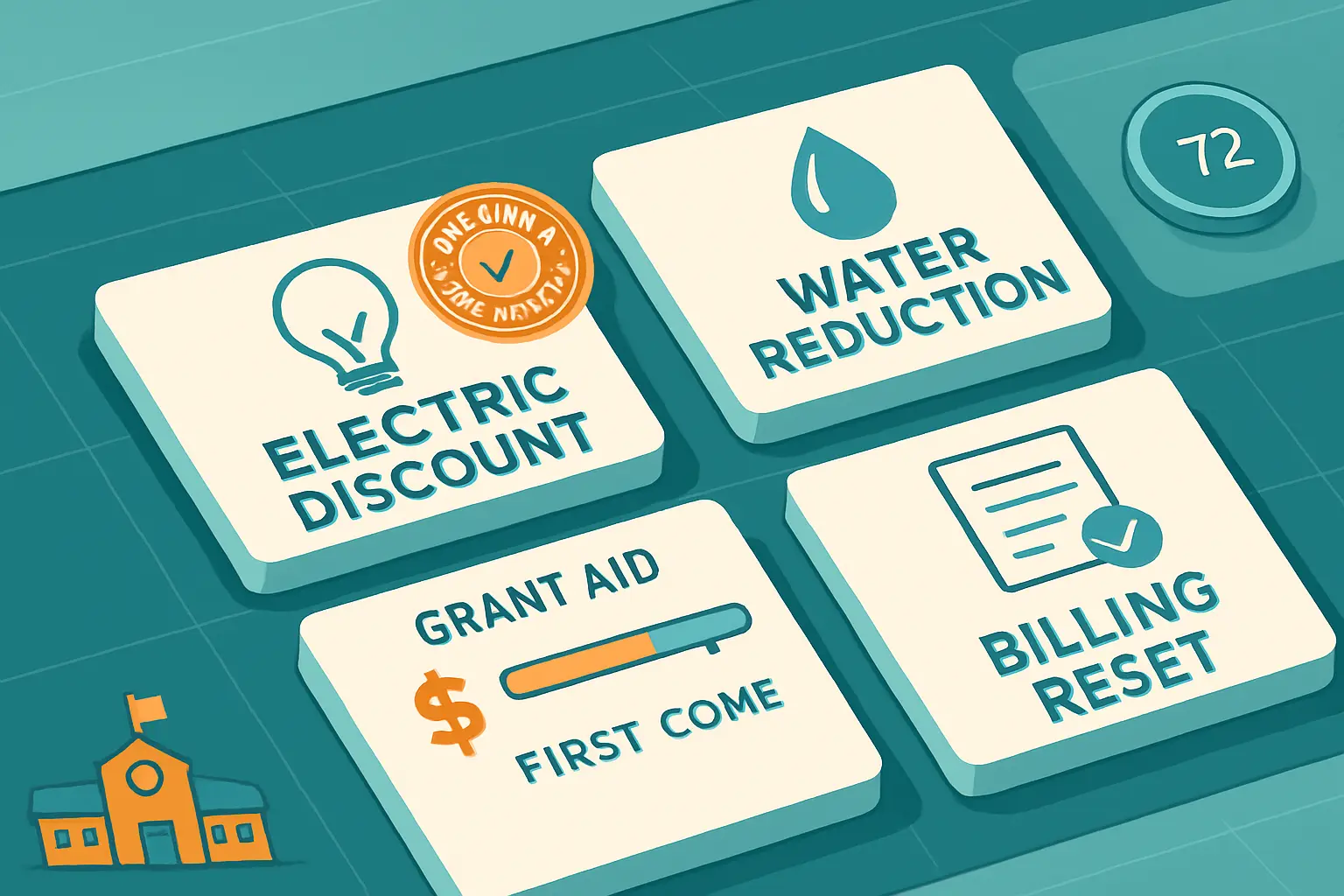
Many people think assistance only means emergency aid. In practice, utility companies often have several tools that affect what shows up each month. One of the first things to review is whether you are on a balanced billing or budget billing plan and whether that amount is about to be recalculated after a heavy summer. A reset can help or hurt, depending on how much cooling use piled up.
Call customer service or log into the account portal and ask clear questions. Is there an annual recalculation coming? Can the due date be moved closer to payday? Is there a lower-cost billing option if the household income has changed since last year? Some utilities also offer autopay credits, paperless billing discounts, or lower deposits for customers with improved payment history.
If your household recently changed, mention that too. A child starting school, a parent returning to work, reduced hours, or a move from one address to another can all affect eligibility for local utility support. Even if the company itself does not offer a direct break, it may point you to a partner charity, city program, or state-run intake agency that does.
Review the last two bills side by side and write down current charges, average use, and any arrears. That small bit of prep makes the next call much more productive.
Look for recurring local discounts before chasing one-time crisis aid
Monthly reductions can be more valuable than a single payment if the budget is going to stay tight through the school year.
The strongest utility relief is often the one that keeps helping after September, not just the grant that fixes one stressful statement.
Several current programs show how big recurring help can be. In Seattle, the utility discount program offers qualified households 60% off electricity and 50% off water, sewer, and garbage charges, with updated income rules in 2026. That kind of ongoing reduction can matter far more than waiting for a last-minute emergency.
Other large utilities are also offering income-based discounts. In Illinois, eligible customers may be able to review the low-income electric discount connected to ComEd coverage. In New York, Con Edison says more households may qualify under its affordability discount program after a 2026 expansion.
These examples matter because they show a pattern: some households qualify for percentage-based monthly relief, not only shutoff prevention. City-owned utilities, regional power companies, and combined water systems may each have separate rules, so search your provider name plus terms like discount, affordability, customer assistance, or income-qualified plan.
When comparing options, ask:
- Is the savings monthly or one time?
- Does it cover only electric service, or water and trash too?
- Do you have to renew every year?
- Will approval start right away or only after processing?
That is often the difference between short-term relief and a school-year budget improvement.
Use hardship grants and matching programs if the summer balance is still hanging around
If back-to-school costs are landing on top of an older utility balance, targeted grants may stop that carryover from poisoning the fall budget.
A recurring discount helps future bills, but a past-due balance still needs its own plan or it can keep showing up month after month.
Some households do not need a broad monthly discount as much as help cleaning up what summer already left behind. That is where utility-linked grants can matter. Programs administered through Dynegy Energy Aid, the Ohio utility help program, the FirstEnergy hardship grant, and the Arkansas assistance route all show a common model: one-time bill help for eligible customers, often on a first-come basis while funds remain.
California customers dealing with arrears may also want to review PG&E’s matching-payment relief, which can match customer payments up to a listed cap for qualifying households while funds last.
These programs are not identical. Some only help if service is already off or near termination. Others can apply to past-due amounts before disconnection happens. The timing matters because many are first come, first served.
If you think your household may qualify, gather:
- A recent utility bill
- Photo ID
- Proof of income for the household
- Any disconnect or late notices
- Account numbers for each service involved
Then ask whether applying for the grant also pauses fees or collections while the review is pending. That one question can prevent a smaller problem from growing while school-year expenses ramp up.
Do not overlook city help and processing rules when the account is not in crisis yet
Municipal utility support can be worth checking even when service is still on and the main issue is timing, not shutoff.
Some of the best local utility support is easy to miss because it sits on a city services page rather than a power-company alert.
City-run or city-linked utility aid can work differently from investor-owned utility programs. In Bellevue, Washington, the city’s utility assistance page notes that applications can take weeks to process because of high demand, but approved help may apply retroactively to a stated 2026 date with no late fees. That kind of detail matters if a household gives up too early after seeing a wait time.
Municipal systems may also combine services. Electric, water, sewer, and garbage might be bundled, which means one application could affect several budget lines at once. That is especially helpful for families trying to avoid death by a thousand cuts during the school season.
Look beyond the utility website itself and search your city human services department, public utilities page, or community services office. If your bill includes water or trash through a local government, the support may live there rather than through a statewide energy agency.
Ask practical questions when you call:
- Is long-term help different from emergency help?
- Does approval work retroactively?
- Will late fees stop while the application is open?
- Can renters apply, or only account holders and owners?
Those details can shape whether the program is worth pursuing right now or whether a payment arrangement should be set up first while you wait.
Make a back-to-school utility review plan before the first colder bill shows up
A short review this week can uncover lower monthly costs, cleaner balances, or steadier billing before autumn expenses pile higher.
The easiest utility savings to use are usually the ones found before the household is reacting under pressure.
If you want a practical next step, keep it simple and time-boxed. On day one, review your latest statement and account settings. On day two, call the utility and ask about budget billing resets, recurring discounts, due-date changes, and hardship options. On day three, search for local city or county help if the account includes water, sewer, or trash. On day four, gather documents and submit any applications that seem realistic. On day five, confirm whether anything is pending and whether the utility will note that on the account.
A useful checklist looks like this:
- Check whether balanced billing will be recalculated soon
- Ask about recurring affordability discounts
- Review one-time hardship grants for any old balance
- Search city utility pages for water or combined-service aid
- Save screenshots, confirmations, and call notes
- Recheck the account before the next bill closes
Back-to-school season is already a financial reset for many families. It can also be a good time to reset a utility account before fall rates, heating use, or leftover summer balances take over the budget. Take a few minutes today to check which discounts, grants, or billing adjustments may fit your household now.