
Think a Summer Blackout Left You Owed Utility Credit?
The lights came back, but the account still may not be settled. After a summer outage, some households wonder whether the power company owes a bill adjustment, a spoiled-food credit, or another account fix. That answer depends on your utility’s tariff, state rules, outage cause, and the kind of loss involved. The useful part is this: if you think your account should show a credit after an outage, there is a practical way to check instead of guessing.
This is not the same issue as finding help with a high electric bill during hot weather. Here, the question is narrower and more procedural: was there a service-related credit, deposit reversal, overcharge correction, or outage-related claim path that applies to your situation? Some credits post automatically. Others require a request. Some losses, such as hotel costs or food spoilage, may need a separate claim process if one exists at all.
Start with your utility’s rules, your outage timeline, and your next statement. Those three pieces usually tell you whether you are looking at a billing correction, a customer-service request, or a complaint worth escalating.
Start by checking whether the utility even offers outage-related bill adjustments
The first job is to find the exact account rule that governs credits, claims, or refunds after an interruption.
A long outage feels unfair on its own, but the strongest request is one tied to a written utility rule rather than a general sense that compensation should happen.
Utilities do not all handle outages the same way. Some have reliability standards or service-guarantee rules approved by state regulators. Others may only offer credits in narrower situations, such as billing errors, extended interruptions, or equipment-related losses handled through a claims unit. That is why the best first move is to look for the utility’s tariff, customer rights page, or outage claims section on its official site.
Use focused search terms inside the company site: outage claim, service interruption credit, reliability credit, customer guarantee, spoiled food claim, billing adjustment, tariff, or compensation. If you cannot find it online, call and ask a direct question: what written policy covers customer credits or claims after a prolonged summer outage?
It also helps to separate possible paths:
- Automatic bill credit for certain service failures
- Correction if estimated billing or meter timing created an inaccurate charge
- Claim form for food, medicine, or equipment losses if the utility offers one
- No direct compensation, but a possible complaint path through your state regulator
Many states route utility oversight through a state consumer or utility office, while specific utility complaint and tariff rules often sit with a public utility commission. If your provider’s website is vague, your state commission page can help you see whether customer credit rules or service-quality standards exist in your area.
Before moving on, save screenshots or PDFs of anything that mentions outage-related credits, claims deadlines, or service guarantees. That paper trail matters later.
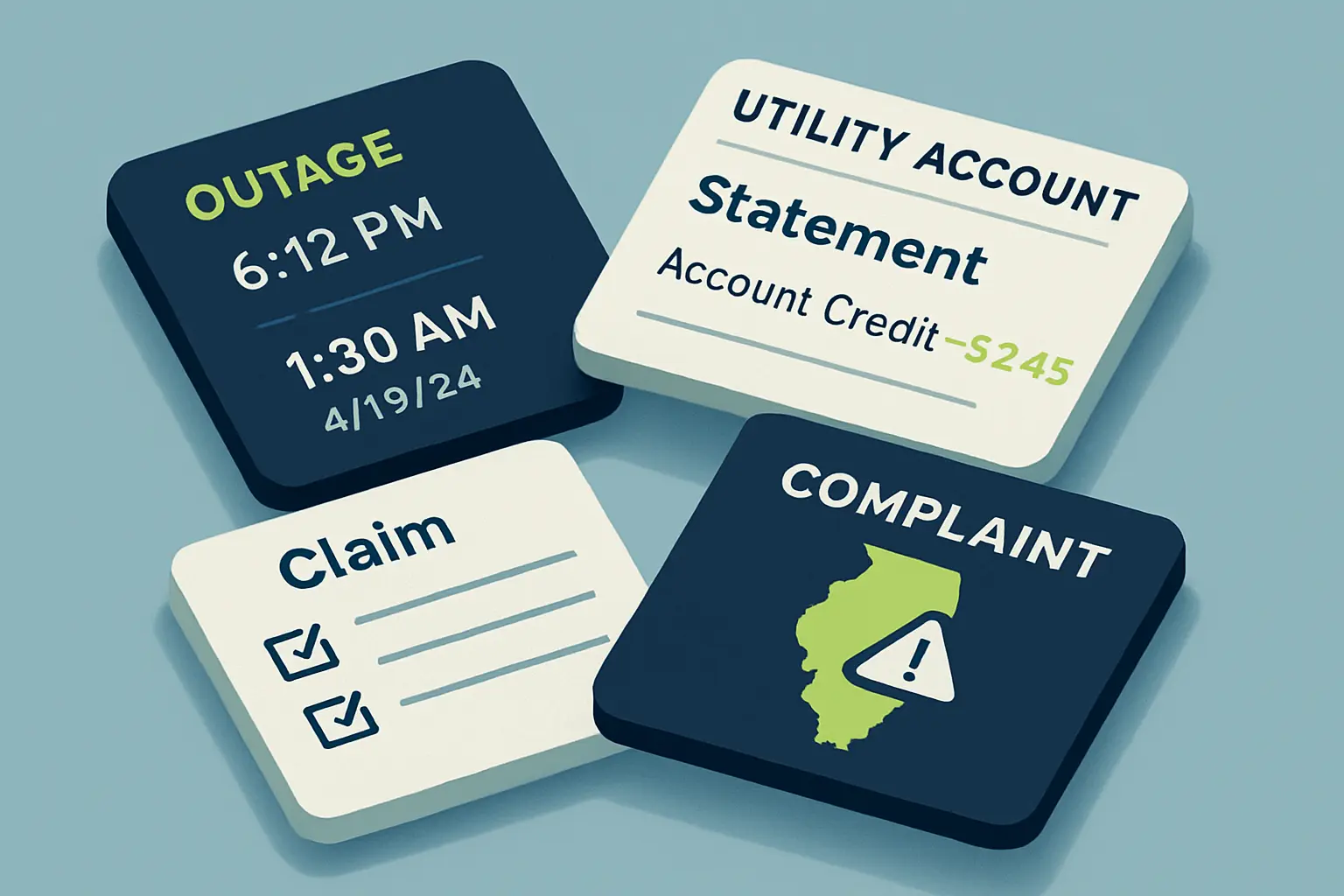
Build a simple outage file before you contact the company
Your case gets stronger when the dates, losses, and bill details are organized in one place.
The more specific your timeline is, the easier it becomes to show whether the outage matched a policy trigger or whether the bill still includes a charge that deserves review.
Do not rely on memory alone. Create a small folder on your phone or computer with the start time of the outage, when power returned, outage-alert texts or emails, photos if relevant, and your next one or two bills. If your utility’s app showed outage status updates, take screenshots. If neighbors lost power too, note that briefly, especially if the outage was neighborhood-wide and prolonged.
Then compare the outage period with the bill. Look for anything odd, including an estimated reading, a catch-up charge, or a balance that seems too high for a period when service was out. A credit may not always be tied to losses; sometimes the real issue is a billing inaccuracy after the interruption.
Your file should include:
- Service address and account number
- Date and time power stopped
- Date and time service returned
- Any text, email, or outage-map notices from the utility
- The next utility statement and, if possible, the prior one
- Notes on food loss, medicine spoilage, hotel stays, or damaged equipment
- Receipts, if you had to replace essentials
If the outage affected medication storage or medical devices, note that clearly. Even if the utility does not directly reimburse you, that fact may matter when speaking with the company, a consumer advocate, or a regulator. If the outage pushed you into financial strain, you can also keep links to support resources such as 211 referrals or energy assistance options nearby, since separate bill help may still matter while a dispute is reviewed.
Ask for the right kind of review instead of making a broad complaint
A focused request usually works better than asking generally whether you are owed something.
Customer-service teams respond faster when you name the exact issue: a tariff-based credit, a spoilage claim, a service-guarantee payment, or a billing correction tied to the outage period.
Once your records are ready, contact the utility through an official channel that creates a record, such as secure message, email, or a web form. Phone calls can help, but written follow-up is better. Keep the message short and specific. State the outage dates, the length of the interruption, and what you are asking the company to review.
Examples of useful requests include:
- Please review whether my account qualifies for any service interruption credit under your current rules
- Please review whether this bill includes an estimated or inaccurate charge connected to the outage period
- Please send the process for filing a claim for spoiled food or outage-related losses if available
- Please identify the written policy that applies to compensation or credits after an extended interruption
Ask for the answer in writing. If a representative says there is no credit available, ask which tariff, service rule, or customer policy they are relying on. That single question often reveals whether the answer is final or just a quick front-line response.
Keep a contact log with the date, time, representative name, and any case number. If the company promises a reply within a certain number of days, write that down too. Utilities sometimes have formal complaint units, claims departments, or escalation teams separate from standard billing support.
If your issue is specifically about a wrong bill after an outage, emphasize the charge itself. If your issue is a loss like spoiled food, be ready for a separate claim track. Those are often handled differently, and some utilities may deny them unless very specific conditions apply. The important part is matching your request to the correct lane early.
Escalate to your state utility regulator if the reply does not make sense
State oversight offices can help when the utility’s explanation is unclear, inconsistent, or unsupported by its own rules.
An outside complaint is most effective when it includes the utility’s written reply, the outage timeline, and the exact reason you believe a credit or review was mishandled.
If the company rejects your request and the answer feels incomplete, the next stop is often your state’s public utility commission or consumer affairs office. Most commissions have complaint pages for residential customers and will ask for basic records, including your account information, what happened, and what resolution you want.
Search your state plus public utility commission complaint, or start with a general state agency finder and move to the utility regulator from there. Some states also have a utility consumer advocate or ratepayer advocate office that can explain the complaint process in plainer language.
When you file, include:
- Your account number and service address
- The dates and length of the outage
- The exact credit, refund, or billing review you requested
- The utility’s written response or case number
- Screenshots, notices, receipts, and bill copies
- A short statement of why you think the answer conflicts with company rules or state standards
Be realistic about the goal. A regulator may not award every claimed loss. But it can sometimes push the utility to explain itself properly, correct a billing issue, or review whether an account should have received a posted credit. That alone can matter if your request has been bouncing around customer service without a clear answer.
If the outage created broader hardship, you do not need to wait for the complaint outcome before exploring payment arrangements or assistance. That parallel step can keep the account stable while the dispute moves.
Use a short next-step plan so the issue does not drag on for months
A simple one-week checklist can help you move from suspicion to a documented answer.
The best time to challenge a missing utility credit is while the outage details, statements, and company records are still easy to gather.
Keep the process practical. Day one, pull the utility’s outage or claims policy and save it. Day two, build your outage file with times, notices, and bills. Day three, send a written request asking for the exact review you want. Day four or five, follow up if no case number appears. Day six, decide whether the reply makes sense. Day seven, prepare a state complaint if needed.
Use this checklist:
- Find the utility’s written policy on interruption credits, claims, or billing review
- Save outage alerts, app screenshots, and the next statement
- Document any spoilage, hotel, medication, or equipment loss
- Ask the utility in writing for the exact review that fits your issue
- Request the policy basis for any denial
- Keep case numbers and representative names
- Escalate to your state’s utility regulator if the answer stays unclear
This topic can be frustrating because many people assume compensation is automatic when it often is not. Still, that does not mean there is nothing to check. A posted credit, corrected bill, or claim path may exist, and the only reliable way to find out is to match your outage to the written rules and document every step.
If a summer blackout left you wondering about a missing utility credit, check your account rules and local complaint options today to see which relief or correction path may fit your situation.