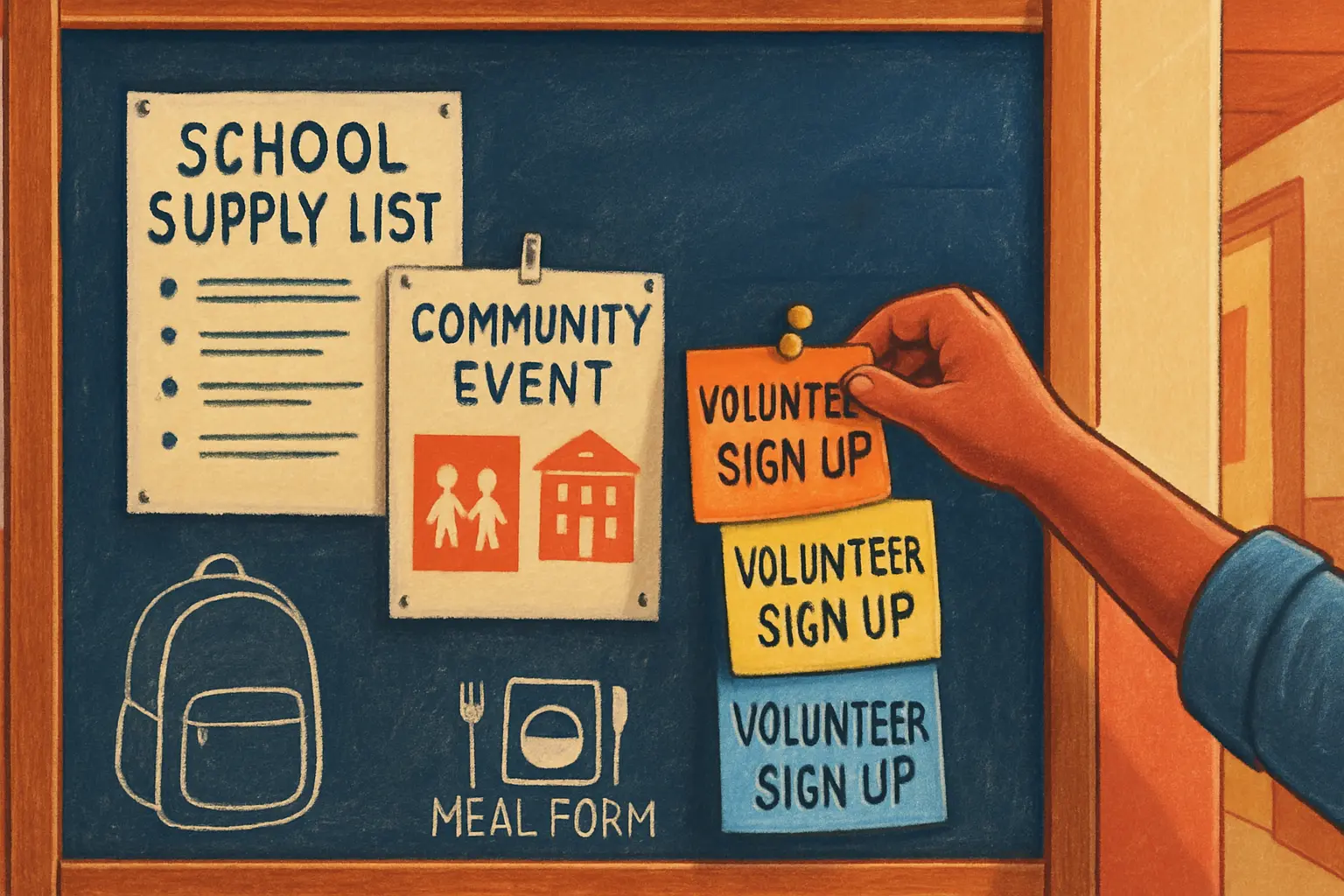

Can School Volunteer Time Help Lower Back-to-School Costs?
A parent signs up to help at a school event, a church giveaway, or a community supply drive and starts wondering whether that time can do more than feel good. In some places, it can. Not usually as cash, and not through a universal national program, but sometimes through family fee credits, access to school communities that share supplies, early notice about giveaways, or local programs that connect volunteers with practical support before classes start.
That distinction matters. Volunteer hours do not automatically turn into school supply discounts in 2026, and families should be cautious about anyone implying otherwise. Still, volunteer-based opportunities can fit into a broader savings plan when combined with school meal applications, community backpack events, clothing giveaways, and local school support drives.
The better question is not whether volunteering creates a direct paycheck replacement. It is whether your time can open doors to legitimate help while you also pursue the more standard back-to-school benefits available in your area.

Where volunteer time can help, and where families should keep expectations realistic
Volunteer service is most useful as a connection point, not as a guaranteed discount engine.
In many communities, the real savings from volunteering come from being closer to trusted local programs, not from a formal hour-for-dollar exchange.
Some private or faith-based schools ask families to complete service hours, and certain schools may reduce a fee or charge a separate amount if those hours are not completed. A published school volunteer policy shows how family service expectations can be structured in one school setting. That is a real example of volunteer time having financial value, but it is school-specific, not a standard public benefit.
Outside that kind of arrangement, volunteering can still matter in practical ways. Families who help with local supply drives or school support events may hear about backpack distribution days earlier, learn which offices handle clothing aid, or get connected to counselors who know about fee waivers, transportation help, or classroom wish-list assistance. That is useful, but it should be treated as access to information, not as promised compensation.
It also helps to separate three different scenarios:
- A school where family service hours are tied to school fees or participation expectations
- A nonprofit or church where volunteers help run a giveaway that may also serve local families
- A general community event where volunteering builds relationships but does not create personal eligibility for aid
If a program suggests volunteers receive a benefit, ask for the rule in writing. Families should know whether the help is a formal policy, first-come access, or simply a referral to other resources.
Community supply drives may be the easiest place to stack help
Supply drives can lower out-of-pocket costs directly, whether or not a family volunteers at the event.
Backpack and supply events often save the most money when families use them early and combine them with other school-season support.
Community back-to-school events are one of the clearest places to reduce spending. Some organizations collect backpacks, notebooks, pencils, and other essentials for students who need them. In Kansas City, school supply help through ScrapsKC is built around community support and distribution. In Colorado, the Douglas County Schools foundation runs a summer supply campaign aimed at getting backpacks and classroom basics to students. Another example is a local school-season event that advertises backpacks, supplies, and clothing for families in need.
These are local examples, but they show the pattern families should search for in their own area. Look for school districts, education foundations, ministries, and nonprofit groups using terms like backpack giveaway, supply distribution, or school readiness event.
Volunteering at one of these events can be worthwhile, but families should not assume it changes eligibility. Instead, use the event to learn:
- Whether registration is required
- What documents are needed
- Whether clothing or hygiene items are included
- Whether school staff or social workers will be present
- Whether there are separate distributions for older students
If supplies are limited, timing matters. Some events run out early, and some give priority to enrolled district families or households meeting local criteria.
Do not miss the standard benefits that usually save more than volunteer perks
The strongest savings usually come from mainstream school and household benefits, with volunteering acting as a supplement.
Families can lose more money by overlooking school meal forms or basic aid applications than by missing any volunteer-related opportunity.
Volunteer opportunities can be helpful, but the heavier financial lifting often comes from formal benefits. School meal applications are a major example. If your district requires a form for free or reduced-price meals, completing it can reduce costs throughout the year and may also support eligibility for other school-related discounts or fee reductions, depending on local policy.
Back-to-school aid guides like this school cost support overview also point families toward clothing help, school-supply programs, and technology-related assistance. Those routes are often time-sensitive, and some are limited by funding.
Families under broader budget strain may also want to review:
- SNAP, if grocery costs are already tight
- WIC, for younger children in eligible households
- District fee waivers for activities or materials
- Local clothing closets or uniform exchanges
- Library resources for printing, homework, or device access
If your child needs a calculator, laptop, hotspot, or internet access, ask the school and library both. Some costs that feel like school-shopping problems are really technology-access problems, and the solution may come from a separate community service.
The practical lesson is simple: treat volunteer-based savings as one layer. The bigger base layer is official and school-connected aid that may already exist whether or not you serve at an event.
How to ask the right questions before giving your time
A short fact-check can help families avoid misunderstanding what a volunteer role does and does not offer.
Before signing up, ask whether the opportunity provides a formal family benefit, informal resource access, or simply a chance to help others.
Volunteering is valuable on its own, but when a household budget is tight, it is fair to ask practical questions. The key is asking in a respectful, direct way. If you are considering school volunteer work, a church drive, or a nonprofit supply event, ask the organizer:
- Does this role include any fee credit, supply access, or referral priority for volunteers?
- Is that benefit written somewhere families can review?
- Are volunteers also allowed to register for the event if they meet eligibility rules?
- Will school staff or case workers be available to answer benefit questions?
- Are there related programs for clothes, shoes, or classroom fees?
If the answer is no, the opportunity may still be worth doing, especially if it builds school relationships or helps your neighborhood. But it is better to know that upfront than to assume help is attached.
For school-based service requirements, ask separate questions:
- How many hours are expected?
- Is there a financial charge if the hours are not completed?
- What kinds of service count?
- Can the requirement be adjusted for work schedules, disability, or caregiving needs?
That matters especially for private-school families, where service expectations can quietly affect the total cost of attendance.
A simple savings plan for families trying to trim school costs now
The most effective back-to-school strategy is to combine local events, official benefits, and carefully chosen volunteer opportunities.
School-season savings often come from layering several small supports at once rather than waiting for one big solution.
Start with a one-week plan. First, ask your school about meal forms, fee waivers, technology help, and any supply events. Next, search local nonprofits, district foundations, churches, and 211 for backpack or clothing distributions. Then decide whether a volunteer role makes sense as a way to build connections or meet a school requirement, not as a substitute for applying elsewhere.
Use this checklist:
- Check your school or district for meal, fee, and supply forms
- Search local backpack and clothing events in your area
- Ask whether family volunteer hours affect fees at your school
- Confirm any volunteer-linked benefit in writing
- Use libraries and community centers for tech and printing support
- Apply early, because many school-season programs are limited
Not every family will find a direct money-saving link between volunteer hours and school costs. But many will find something just as useful: better information, earlier access to community events, stronger ties to school support staff, and one more path to stack with formal assistance.
If school shopping is already stretching the budget, check what your school, community groups, and local benefit programs offer today. A few small layers of help may ease more of the total than expected.