Which Student Loan Relief Path Fits a New Grad This Summer?
You finish school, the grace period starts moving, and suddenly every student loan option seems to come with a different rule, deadline, or promise. For summer 2026 graduates, the real challenge is not finding a plan name. It is figuring out which repayment or forgiveness path actually matches your loan type, job plans, and starting income.
This is a different question from handling a sudden bill jump after an older plan change. New graduates are often starting closer to the beginning: choosing a first plan, deciding whether forgiveness is realistic, and avoiding a move that looks cheap now but costs more flexibility later.
Federal repayment tools can help, but the best route depends heavily on whether your loans are eligible federal loans, whether you expect low starting income, and whether public service, teaching, or another qualifying field is part of your career path. A borrower heading into government or nonprofit work may need a very different setup from someone entering a higher-paying private-sector role and planning to pay aggressively.
The safest starting place is your federal student aid account, along with the loan simulator. Those two tools can help you compare federal student loan repayment options before your first required payment becomes the default path. 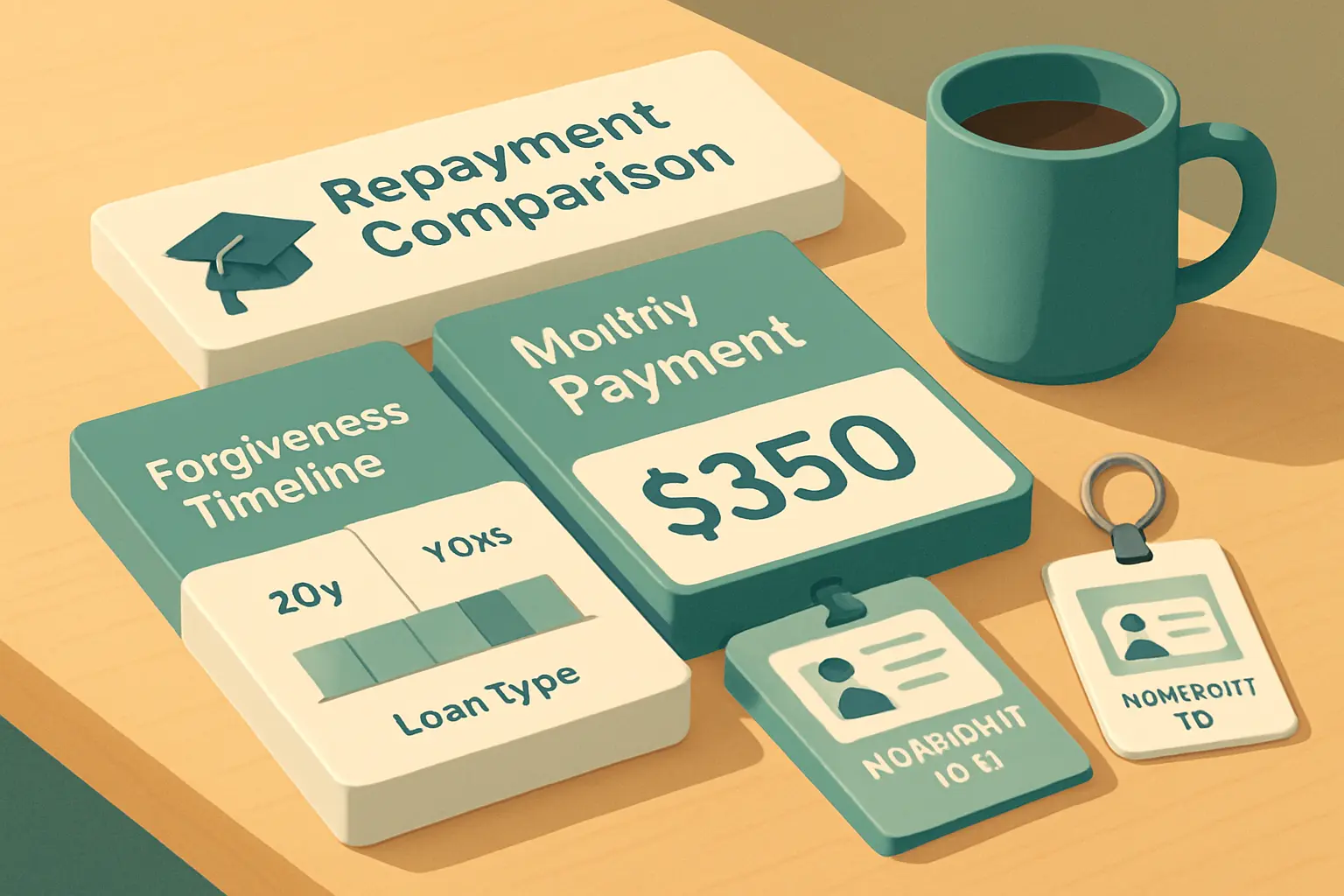
Start with loan type before you chase the lowest monthly bill
Your first useful comparison is not plan versus plan, but loan eligibility versus your actual account details.
A repayment choice that looks perfect on a chart can be the wrong move if your loans, consolidation history, or career plans do not line up with it.
Before comparing monthly payments, confirm what you actually borrowed. Log in and review each loan separately. Look for Direct Loans, any consolidation loans, and whether any Parent PLUS debt appears in the history. That one detail can narrow the menu faster than anything else.
For many new graduates with eligible federal loans, the main repayment discussion in 2026 centers on income-based options such as IBR, PAYE, ICR, or newer assistance structures discussed in 2026 coverage. Consumer guides comparing income-driven repayment plans and side-by-side reviews of repayment plan differences can help you understand the broad tradeoffs, but your real answer still depends on what the federal system says your loans can enter.
That is why your first checklist should be simple:
- Confirm each loan type individually
- Check whether any loan was consolidated already
- See if Parent PLUS borrowing is involved anywhere
- Read any servicer notices about available plans
- Save your current balance and grace-period end date
Many graduates make the mistake of optimizing only for the smallest payment. That can be reasonable if income is low and unstable. But if your long-term goal is forgiveness through public service, or a faster private payoff, the right setup may not be the same as the smallest first number shown.
In short, use your actual loan data first, and treat blog comparisons as background rather than a final answer.
Income-based plans help most when starting pay is modest or career direction is still shifting
For many 2026 graduates, income-linked repayment is worth serious attention because it can create breathing room while work and salary are still settling.
A smaller required payment can be valuable early in your career, but the long-term cost and forgiveness timeline still deserve a side-by-side review.
If you are entering a field with lower starting pay, piecing together part-time work, or unsure how stable your first job will be, income-driven repayment may be the most practical lane to review first. These plans generally tie the monthly bill to income and family size instead of using the fixed payment logic of the standard schedule.
That can make a big difference during your first one or two working years. It may also help if you are moving, job-hunting, or starting in a field where raises come slowly. Updated explainers covering 2026 repayment plan comparisons and differences between SAVE-era alternatives and older IDR choices show why the details matter: payment formula, repayment length, recertification rules, and treatment of unpaid interest are not identical.
That said, income-based repayment is not automatically the best path for every graduate. It often makes the most sense when at least one of these is true:
- Your starting salary is low relative to your balance
- You need payment flexibility while building a career
- You may pursue forgiveness later
- You expect family-size or income changes soon
- You want to avoid being pushed into an unaffordable standard amount
On the other hand, if your balance is moderate and your income is rising quickly, a standard or faster repayment route may cost less overall. That is where the simulator becomes useful. Run at least two scenarios: one based on affordability now, and one based on paying the debt down faster. The goal is not to guess. It is to see how the tradeoffs actually look with your own numbers.
Forgiveness paths are strongest when your job choice already matches the rules
Loan forgiveness works best as a career-aligned strategy, not as a vague hope attached to any repayment plan.
The borrowers most likely to benefit from forgiveness are usually the ones whose work setting, loan type, and payment plan all fit the program rules from the start.
Forgiveness can be real, but it is most useful when your employment naturally fits a qualifying lane. If you are headed into government, public education, a qualifying nonprofit, or another eligible public-interest employer, the most important forgiveness route to understand is Public Service Loan Forgiveness. That path depends on qualifying employment, qualifying loans, and qualifying payments over time.
Graduates entering teaching may also want to compare Teacher Loan Forgiveness, though it works differently and may not combine with every other strategy in the way people assume. Broader overviews of student loan forgiveness programs in 2026 can help identify which career-specific opportunities are worth exploring.
What matters here is honesty about your plans. If you are not actually aiming for qualifying public-service work, choosing a plan mainly because forgiveness sounds nice can backfire. You may end up carrying debt longer than needed without ever meeting the job requirements.
Forgiveness becomes much more compelling when:
- You already have or expect qualifying public-sector or nonprofit work
- Your loan balance is large compared with likely earnings
- You expect to stay in that employment lane for years
- Your repayment plan supports qualifying payment treatment
Keep records early. Save employer certification, payment records, and copies of plan enrollment confirmations. Graduates who treat forgiveness as paperwork from day one usually avoid more confusion later than those who wait several years and then try to reconstruct their history.
Standard repayment can still win for graduates who want debt gone fast
Not every new graduate needs a forgiveness-first or income-first strategy, especially if the balance is manageable and income is solid.
A predictable fixed payment can be the smartest choice when the monthly amount fits comfortably and your goal is clearing the debt instead of stretching it.
Standard repayment is easy to overlook because it lacks the headline appeal of lower monthly bills or forgiveness. Still, it can be a strong fit for graduates whose debt is modest, whose income is already stable, or who want to simplify the whole process and be done on a shorter schedule.
This route deserves a real comparison if you are entering a field with dependable pay or living at home temporarily while you get established. You may discover that the standard plan costs less in total and reduces decision fatigue. For some borrowers, that is worth more than the flexibility of income-based options.
It is especially worth pricing out if:
- You can handle the monthly amount without crowding out essentials
- Your loan balance is relatively low
- You expect raises or bonuses soon
- You are not pursuing public-service forgiveness
- You want fewer annual paperwork steps
There is also a middle-ground mindset here. Some graduates start with an income-based option because cash flow is tight, then switch later after income improves. Others begin on the standard plan and pay extra when possible. The right answer does not have to be permanent on day one, but it should be intentional.
The useful comparison is this: would a lower required payment truly protect your budget, or would it mostly delay payoff while interest and timing keep the loan in your life longer? For a borrower with strong earnings and a moderate balance, the simpler route may actually be the cheaper one.
Use a first-summer decision checklist before your grace period ends
A short, organized review this summer can help you choose a workable path before autopilot chooses one for you.
The best first repayment choice is usually the one made after one honest hour of review, not after months of avoiding servicer emails.
Keep the process grounded. Start with your federal account, not social posts. Review your loans, compare at least two payment scenarios, and match the plan to your real career direction.
Try this same-week checklist:
- Log in to StudentAid.gov and verify every loan type
- Note your grace-period end date and current servicer
- Run the Loan Simulator using current income estimates
- Compare one income-based option against standard repayment
- If public service or teaching is likely, review the qualifying rules now
- Save screenshots, notices, and any enrollment confirmations
- Set a reminder to revisit the plan if income changes after your first job shift
If you feel stuck, a nonprofit student loan counselor or your servicer may help explain the mechanics, but be careful with companies selling enrollment help as if they control federal access. Outside firms cannot create eligibility you do not have.
The good news is that summer 2026 graduates do have choices. The key is picking the route that fits your loans and life as they actually are, not as a repayment chart makes them seem. Check your loan details, compare the realistic paths, and see which program setup may fit your next step today.