

Which Rent Reporting Option Fits If You Want Credit Help Cheap?
You pay rent every month anyway, so it is reasonable to ask whether that same payment can do more for your credit file. Rent reporting services try to solve that problem by sending your on-time rent history to one or more major credit bureaus. For renters with thin credit, past credit damage, or no current loan accounts, that can be a useful option to explore.
The catch is that these services are not all built the same way. Some report to only one bureau. Some charge a monthly fee. Some can add older rent history from past months, while others only start counting after you enroll. And some work best only if your lender, landlord, or future creditor actually looks at the bureau they report to.
This is also a different question from fixing a credit report error. Here, the issue is not removing bad information. It is deciding whether a rent-reporting service is worth using in the first place, and if so, which type best matches your budget and credit goals.
If your goal is a payment-free or low-cost credit-building step, the smartest move is to compare bureau coverage, backfill rules, and ongoing cost before signing up. 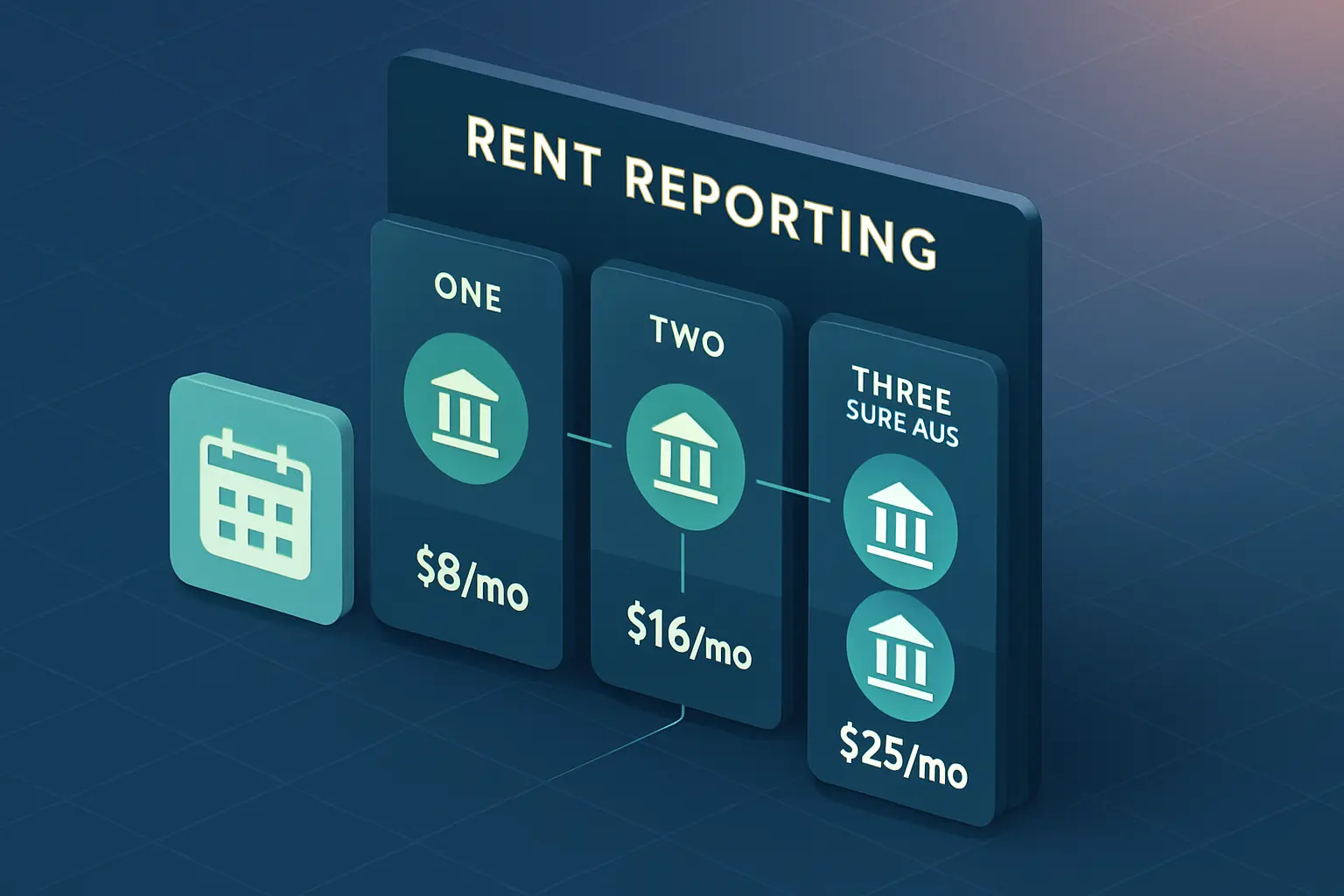
Why rent reporting can help some renters but still disappoint others
The biggest detail is where your rent history is reported, because one bureau is not the same as all three.
A renter may do everything right and still see uneven results if the service reports to only one credit bureau while a future lender checks another file.
Rent reporting sounds simple on the surface: pay rent on time, get credit. In practice, the outcome depends on a few moving parts. First, not every scoring model treats rent history the same way. Second, some lenders rely more heavily on one bureau than another. Third, a service that looks free may only report to a narrower slice of the credit world than a paid option.
That does not make the lower-cost services bad. It just means expectations should stay realistic. A renter trying to build basic file depth may decide that one-bureau reporting is a useful first step. Another renter preparing for an auto loan, apartment screening, or mortgage shopping may want broader reporting so more creditors can actually see the history.
Backdated reporting matters too. If a service can add up to 24 months of older on-time rent, that may help create a faster credit-history boost than starting from zero today. But backfill often comes with limits, verification rules, or an extra charge.
Before comparing brands, answer three questions:
- Do you want the lowest possible cost, even if bureau coverage is limited?
- Do you need older rent history added, or is future reporting enough?
- Are you mainly building a thin file, or trying to strengthen your profile before applying somewhere soon?
Those answers usually narrow the field quickly.
Free and low-cost starters are best for testing the idea first
If you want the easiest low-cost starting point, begin with the services that let you try rent reporting without a heavy commitment.
Starting cheap can make sense when you are not yet sure how much value you will get, especially if you mainly want to add positive activity to a light credit file.
Experian Boost is the obvious first stop for many renters because it is free and can include some payment history on your Experian file, including older qualifying history up to 24 months based on the details provided here. That makes it appealing for people who want to test whether rent-related reporting belongs in their credit-building plan at all. Its main limit is simple: it is centered on Experian only.
Piñata is another option worth checking if you want to stay near the low-cost end. Based on the comparison details provided, it offers a free tier and can report to Experian and TransUnion. That broader coverage can make it a stronger budget pick for renters who want more than one bureau without stepping straight into a monthly paid service. The tradeoff is that it does not offer backdating in this comparison.
These lower-cost paths may fit best when:
- You are new to credit building
- You want to avoid another recurring bill
- You mainly care about adding present and future on-time rent
- You are comfortable with one- or two-bureau reporting instead of all three
If a free or near-free option gives you enough coverage for your goals, that may be all you need. But if you want all three bureaus or older rent history added fast, you may need to look higher up the price ladder.
Paid options make more sense when coverage across all three bureaus matters
Once you care about wider lender visibility, the paid services become easier to justify because they report more broadly.
Paying a monthly fee can be reasonable when the goal is not just adding rent history somewhere, but making that history visible across all three major bureaus.
Rental Kharma stands out for all-three-bureau reporting and the ability to backfill up to 24 months, though the summary provided lists an $8.95 monthly cost plus a $75 backdating fee. That makes it a stronger fit for renters who want broad coverage and have a verified on-time payment history worth adding.
Self Rent Reporting is another all-three-bureau option at a lower monthly price point of $6.95 based on the comparison above. It appears especially relevant for people already using or considering other Self credit-building tools. Backdating is available with an upgrade, so it may work best if you want a linked ecosystem rather than a standalone rent-only tool.
RentTrack also reports to all three bureaus and may be attractive if your landlord already works with it or bundles reporting into the rent process. The provided details list a $6.95 monthly fee and a separate $35 to $55 charge for backdating. That landlord tie-in can make setup easier for some renters.
These paid options are usually more worth comparing when:
- You want all three major bureaus covered
- You expect a lender to pull any bureau, not just one
- You have a solid rent history that may be worth backfilling
- You can support a monthly fee without creating budget stress
The key is not chasing the most features. It is making sure the extra cost lines up with a real credit goal.
Backdated rent history can be valuable, but only if the math works for you
Paying extra for older rent history only makes sense when that older history is strong and likely to matter for your timeline.
A backfill fee can be worthwhile when it adds a long record of on-time payments, but it is harder to justify if your future applications are far away or your rent history is mixed.
Several of the services in this comparison offer some form of older rent reporting. Experian Boost can include older qualifying history up to 24 months. Rental Kharma can also go back as much as 24 months, with a separate fee. LevelCredit reports to Experian and TransUnion and includes backdated history up to 24 months, though the comparison supplied lists a $6.95 monthly fee plus a $49.95 setup fee. RentTrack and Self Rent Reporting can also add prior history, but only with added cost or upgraded terms.
That sounds appealing, but the better question is whether paying for backfill changes anything meaningful for you now. If you plan to apply for credit in the next several months and have a clean rent track record, backdated history may be worth exploring. If you are just gradually building credit and have no near-term borrowing plan, a no-backfill or future-only option might be enough.
It also helps to ask whether your rent records are easy to verify. Services that backfill older payments usually need proof from your landlord, payment portal, bank history, or another reliable source. If that paperwork will be messy, the simpler route may save time and frustration.
A useful quick test:
- Near-term application coming up: backfill may deserve a closer look
- No urgent borrowing plan: future reporting may be enough
- Two-bureau need with backfill: LevelCredit may be worth reviewing
- Three-bureau need with backfill: Rental Kharma, Self, or RentTrack may fit better
Backfill is a tool, not a must-have.
Use a short decision check before signing up for any rent reporting service
The smartest pick is usually the one that matches your next credit goal, not the one with the loudest promise.
Rent reporting works best when it fits into a larger credit plan that also includes on-time bill payments, low card balances, and careful application timing.
If you are deciding this week, keep the process simple. First, confirm whether you want a free trial run, a two-bureau budget option, or full three-bureau reporting. Next, decide whether older rent history matters enough to pay for. Then compare the real cost over a year, not just the monthly number.
Using the comparison details provided, a rough sorting guide looks like this:
- Best no-cost starting point: Experian Boost
- Best low-cost two-bureau budget path: Piñata
- Best all-three-bureau focus: Rental Kharma
- Best fit if you already like the Self ecosystem: Self Rent Reporting
- Best fit if your landlord connection matters: RentTrack
- Best fit for backdated reporting across two bureaus: LevelCredit
Before you enroll, check these points:
- Which bureaus the service reports to
- Whether there is a setup fee, monthly fee, or backfill fee
- How older rent is verified
- Whether your landlord or payment method is compatible
- How easy it is to cancel if the service is not useful
Rent reporting will not replace every part of a strong credit profile, and it does not guarantee a score increase or loan approval. Still, for renters who already make on-time payments, it can be a practical benefit to explore rather than leaving that history invisible. Check which reporting setup fits your budget and timeline today, and you may find that your biggest monthly bill can start doing more work for you.